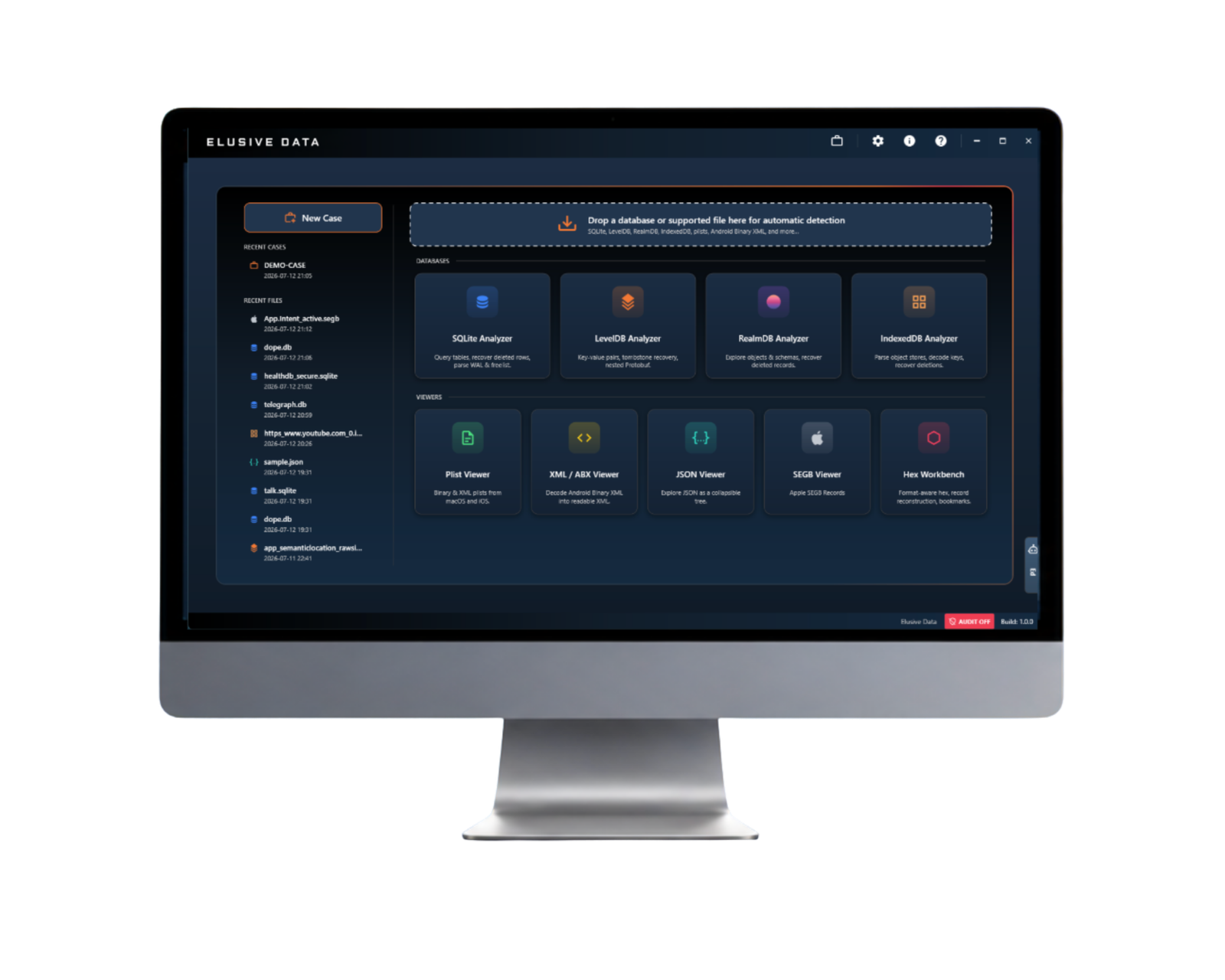
A SQLite viewer can be extremely useful in forensic work. It can show tables, schemas, rows, columns and values quickly. For many first-pass questions, that may be exactly what the examiner needs.
The difficulty starts when the question moves beyond the active table view. Deleted records, WAL-backed changes, freelist pages, freeblocks, overflow content, BLOBs, timestamp interpretation and partially overwritten structures can all change how a SQLite finding should be understood.
This guide is not about dismissing database viewers. It is about knowing when a viewer is enough, when deeper SQLite forensic validation is useful, and which questions help an examiner move from a visible value to a source-backed finding.
- SQLite forensic validation
- SQLite viewer
- SQLite forensic tool
- WAL und SHM
- Deleted records
- Source context
What a normal SQLite viewer is good for
A normal SQLite viewer is often a good place to begin. It can help an examiner understand the schema, inspect active tables, compare columns, run queries and get a quick sense of what an application database contains.
That kind of access is valuable. It can show obvious records, identify table names, reveal timestamp fields, surface message bodies, expose account identifiers and help the examiner decide whether the database deserves deeper review.
A modern SQLite GUI can be excellent for development work. It may help users open files, browse schemas, edit rows, build queries, visualize tables and understand application data quickly. Forensic review asks a different set of questions. The examiner may need to avoid altering source data, preserve related WAL and SHM files, separate active rows from recovered material, and document the path from a reported value back to the database structure that supports it.
The important point is scope. A viewer is usually strongest when the question is about current, accessible database content. Forensic questions often become more complicated when the examiner needs to explain history, deletion, recovery or source context.
A viewer may be enough when
- The examiner only needs to inspect active rows and tables.
- The database is intact and the relevant records are visible.
- The question is exploratory rather than report-critical.
- No deleted, historical, WAL-backed or partially parsed data is involved.
- The finding does not need deeper source-level explanation.
Where a normal viewer can become misleading
A table view can make data feel cleaner than it really is. It presents rows and columns, but it may not show whether a value came from the main database, a WAL frame, a recovered freeblock, a freelist page, an overflow chain or a fragment.
That distinction matters. A visible value may be current. A recovered value may be historical. A fragment may be useful but incomplete. A timestamp may need application context. A record may look familiar while still requiring source validation before it is reported.
The risk is not that the viewer is wrong by default. The risk is that the viewer may not answer the forensic question being asked. When a finding matters, the examiner often needs to know where it came from and what the underlying structure supports.
Specialist SQLite forensic tools have a role
Specialist SQLite forensic tools are often built for questions that go beyond normal database browsing. They may help examiners review WAL and journal files, inspect B-tree structures, work with freelist pages, examine unused space, recover deleted records, handle damaged databases, view hex-level context or prepare findings for reporting.
Those capabilities can be valuable, especially when the database is unsupported by a broader forensic platform or when the examiner needs to understand data that is not visible in the active table view.
The tool still does not remove the examiner’s judgement. A recovered value needs context. A decoded record needs a source. A reportable finding needs enough detail for another examiner to understand how the result was reached and what the underlying structure supports.
The useful question is not only which tool found it
A stronger question is: can the finding be followed back to the file, page, frame, record structure, freeblock, freelist entry, overflow content or byte offset that supports it?
Preserve the database and its sidecar files together
SQLite evidence is not always limited to one database file. Depending on journaling mode and application state, related files such as WAL, SHM or rollback journal files may be part of the picture.
In WAL mode, the main database, the write-ahead log and the wal-index can describe the working state of the database. Forensic review is easier when those files are preserved together and examined from a copy rather than handled casually through the original application environment.
A practical habit is to keep the original source protected, work from a forensic copy and document which files were available during review. If a database is separated from its WAL file, or if a tool opens a copy without the related sidecar files, the examiner may be looking at an incomplete or altered view of the database state.
Why WAL files matter in SQLite forensic work
A WAL file is not just a technical side detail. In WAL mode, SQLite records changed database pages in the write-ahead log before those changes are checkpointed back into the main database. A WAL file consists of a header followed by frames, and each frame records a revised version of a database page.
For forensic work, this can be important because the WAL may contain page versions that help explain recent activity, changed records or values that are not obvious from the main database alone. A table-only view can miss that context or flatten it into a simpler presentation.
A careful review asks where the relevant value was found. Was it in the main database? Was it in a WAL frame? Are there multiple versions of a page? Does the WAL context change how the finding should be described?
What SHM can and cannot tell you
SHM files are often mentioned alongside WAL files, but they do not play the same role. The SHM file is SQLite’s wal-index file. It is used as shared memory to coordinate access to the database and to help locate frames in the WAL quickly.
That makes SHM useful context for understanding WAL-mode activity, but it is different from treating the main database or WAL file as a direct source of database page content. In many cases, SHM may be transient or reconstructed from the WAL.
The practical takeaway is simple: do not ignore SHM, but do not overstate it. It can help explain how SQLite was working with the WAL. It is not a substitute for validating the finding against the database, WAL frames and the relevant record structures.
Deleted records need structure, not just carving
Deleted SQLite data can remain in several places, depending on database activity and what has happened since deletion. Recoverable content may appear in freeblocks, freelist pages, unallocated areas within pages, WAL frames, overflow structures or fragments.
Finding a possible deleted value is only the beginning. The examiner still needs to understand how much structure remains around it. Is there a record header? Can the serial types be interpreted? Is the payload complete? Was part of the record overwritten by SQLite’s internal structures? Is the context strong enough to report the value as a recovered record?
This is where SQLite forensic validation becomes more than keyword searching. A recovered value is stronger when the examiner can connect it to the structure that explains why it is there.
How false positives happen in deleted record recovery
Deleted record recovery is powerful, but it is not magic. False positives can happen when fragments resemble records, when carving rules match incomplete data, when page structures have changed, or when a value is recovered without enough surrounding context.
This does not make recovery unreliable by default. It means recovered material benefits from careful classification. Some findings have strong structural support. Some are useful leads. Some are too incomplete to describe confidently.
A helpful habit is to separate “found text” from “validated record”. The first may help the investigation. The second needs stronger support from SQLite structure, source location and interpretation.
Treat recovered data as stronger when you can explain
- Which file and structure contained the value.
- Whether the value was found in active data, WAL, freelist, freeblock or another area.
- Whether the record header and payload can be interpreted.
- Whether surrounding values support the same record context.
- What has been recovered fully, partially or only as a fragment.
Timestamps need application context
SQLite stores values, but the application decides what those values mean. A timestamp field may represent creation time, modification time, last sync time, server time, local device time, deletion time or another application-specific event.
A viewer can show the value. It may even convert the value into a readable date. But the forensic interpretation still depends on understanding the application, the field name, related records, surrounding activity and any known timestamp format.
Before reporting a timestamp, it helps to ask whether the interpretation is supported by the database context. A converted date is useful. A converted date tied to application behavior is stronger.
A simple validation workflow before reporting
SQLite validation does not need to be complicated. The goal is to create a clear path from the reported finding back to the source material that supports it.
- Identify the value or record that matters.
- Locate the source file that produced it.
- Determine whether it came from the main database, WAL, freelist, freeblock, overflow page or another structure.
- Review the record structure, payload and surrounding context.
- Check timestamp interpretation against application behavior where possible.
- Describe any uncertainty, partial recovery or alternative reading.
- Document enough detail that another examiner can follow the same path.
This workflow is useful because it keeps the finding connected to the evidence. It also makes peer review and reporting easier, especially when a result is important or contested.
Questions to ask when comparing SQLite forensic tools
Many tool comparisons begin with “which tool opens the database?” That is understandable, but a better forensic question is: which tool helps the examiner understand and validate the finding?
For someone searching for the best SQLite forensic tool, the most useful answer may depend on the task. A simple viewer can be the right choice for browsing active tables. A deeper forensic workflow becomes more important when the examiner needs to recover deleted material, review WAL activity, inspect freelists or explain a finding from the source.
Some specialist SQLite forensic tools are built specifically for deleted record recovery, WAL and journal review, B-tree inspection, freelist analysis, corrupt database handling, hex-level examination and reporting. Those capabilities can be valuable. The examiner’s task is still to understand what the tool is showing, how the value was recovered and whether the source structure supports the interpretation.
When comparing a SQLite viewer, SQLite forensic tool or broader database workflow, these questions can help.
- Can the tool preserve and show the source context behind a finding?
- Can it distinguish active records from recovered or historical material?
- Can WAL frames be reviewed without losing the relationship to the main database?
- Can freelist pages, freeblocks and overflow pages be inspected in context?
- Can the examiner see enough structure to evaluate false positives?
- Can findings be exported with useful source references?
- Does the workflow help explain uncertainty rather than hiding it?
No single tool removes the need for examiner judgement. The strongest workflows make that judgement easier by keeping the source visible.
When a viewer is enough, and when it is not
A SQLite viewer may be enough when the examiner is exploring an intact database, checking visible records, reviewing a schema or confirming values already supported by other evidence.
Deeper forensic analysis becomes more useful when the case involves deleted records, WAL activity, unsupported applications, parser disagreement, unusual timestamps, corrupted databases, BLOB content, fragments or findings that need to be explained in detail.
The decision is not about tool loyalty. It is about the question in front of the examiner. Simple questions may need a simple viewer. Source-backed findings need a workflow that can follow the data underneath the view.
A practical checklist for SQLite findings
Before a SQLite finding is reported, these questions can help keep the interpretation grounded.
Before reporting, ask
- Which file produced the value?
- Was it found in the main database, WAL, freelist, freeblock, overflow page or another structure?
- Is the value active, deleted, historical, duplicated or partially overwritten?
- Can the record structure be followed?
- Can the timestamp interpretation be checked?
- Is there a plausible alternative explanation?
- Could another examiner follow the same path from source to finding?
The checklist is deliberately simple. Its purpose is not to slow the examiner down. It helps make sure that the finding remains connected to the source.
Further technical reading
These references are useful for examiners who want to go deeper into SQLite internals and deleted record recovery.
SQLite Forensic Validation FAQ
Is a SQLite viewer enough for forensic work?
It can be enough for active table inspection, schema review and simple queries. Deeper forensic validation becomes useful when deleted records, WAL activity, freelists, freeblocks, fragments or report-critical findings are involved.
What is the best SQLite forensic tool?
The best SQLite forensic tool depends on the task. Some tools are designed for browsing active tables, while specialist forensic tools may focus on WAL and journal review, deleted record recovery, freelist analysis, corrupt database handling, hex-level inspection and reporting. The important question is whether the tool helps the examiner understand the source, validate the finding and explain any limits clearly.
Why do WAL files matter in SQLite investigations?
WAL files can contain changed database pages before they are checkpointed back into the main database. This can provide important context for recent activity, historical page versions and findings not obvious from the main database alone.
Is the SHM file a source of normal database content?
No. The SHM file is the wal-index file used as shared memory to coordinate access and locate WAL frames. It can help explain WAL-mode behavior, but it is different from treating the main database or WAL file as a direct source of database pages.
Can deleted SQLite records always be recovered?
No. Deleted data may remain in recoverable structures, but it can also be overwritten, fragmented or incomplete. Recovery depends on the database state, later activity and how much supporting structure remains.
What is the difference between found text and a validated record?
Found text may be an investigative lead. A validated record has stronger support from its source location, record structure, payload context and surrounding database evidence.
What should be documented before reporting a SQLite finding?
Document the source file, relevant structure, recovery context, timestamp interpretation, uncertainty and enough detail for another examiner to follow the path from source to finding.