
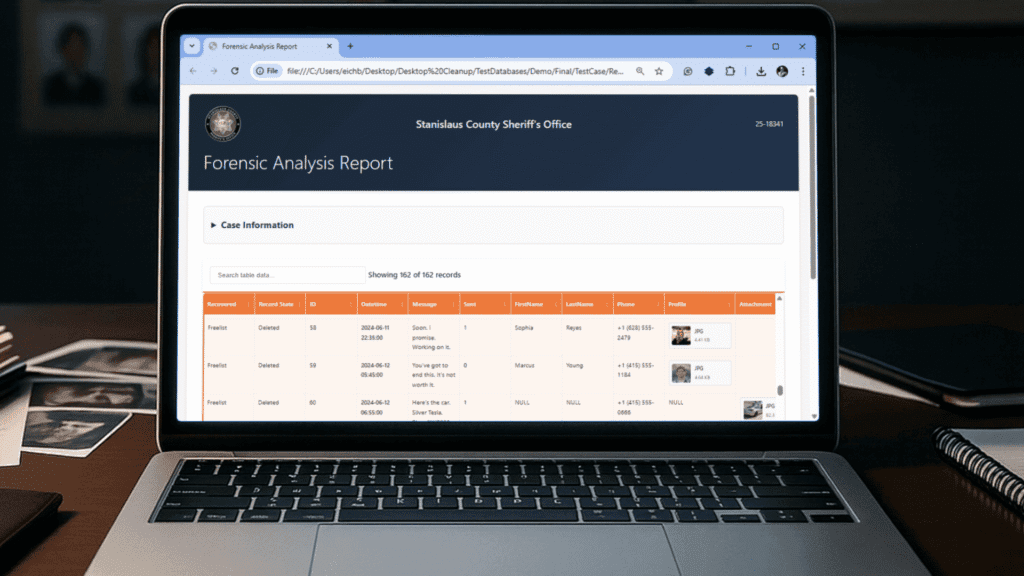
SQLiteVisualizer unifies visual exploration, decoding, SQL analysis, and deleted-data recovery into one seamless workflow. No exports, no tool switching, no lost context.
Built from real casework and years of forensic training, the platform lets you see database history, trace deleted records, and reveal hidden patterns with exceptional clarity and precision. The result: quicker insights, stronger accuracy, and defensible evidence when every detail matters.
The core of the platform is a visual canvas that displays every table, every relationship, every record count, and any custom views as virtual table cards. This delivers an immediate, clear understanding of how an application structures its data, helping examiners grasp the database at a glance.
SQLiteVisualizer includes integrated decoding for plists, protobufs, Base64, GZIP, JSON stitching, Markdown, GPS data, and timestamp formats, everything interpreted directly inside the platform with no exporting or external tools required.
SQLiteVisualizer provides a complete set of examiner-focused recovery tools that expose deleted, historical, and overwritten content across all SQLite storage layers. It recovers data from WAL frames with timeline views, extracts remnants from freelist pages, carves fragmented records from freeblocks, analyzes rollback-journal history, and reconstructs records with full forensic metadata for validation.
SQLiteVisualizer includes a dedicated Hex Analysis Engine built specifically for SQLite forensics, offering automatic decoding of database structures, smart context-aware templates, smooth navigation across pages and frames, fast value and timestamp interpretation, and support for reconstructing fragmented records.
SQLiteVisualizer streamlines SQL work with visual, intuitive tools, letting you build queries directly from the canvas, create context-aware JOINs with a single click, save results as reusable virtual tables, and keep everything organized in a structured, searchable query library.
SQLiteVisualizer generates clear, defensible reports for any case, with flexible evidence and table summaries, interactive HTML output, automatic inclusion of case metadata and hash information, secure ZIP packaging options, and fully customizable report sections to match your agency’s requirements.
SQLiteVisualizer includes a full case-management workflow designed for forensic defensibility. It works in read-only mode, creates protected evidence copies, verifies hashes across multiple algorithms, and captures case metadata and custom fields. Your analysis state and history are preserved across sessions, ensuring every step of your work remains transparent, reliable, and fully repeatable.
SQLiteVisualizer includes a built-in forensic chatbot that you can use in any language, making guidance and SQL assistance accessible to every examiner. It helps you write complex queries, explains SQLite structures like WAL and freelists in simple terms, and supports your workflow without ever accessing evidence data, only the schema. A faster, clearer way to get help right inside the tool.
What I appreciate most is that nothing feels hidden or confusing. I can follow how an app changes its data, notice unusual behavior, and review deleted records without struggling with the tool. It really feels like someone finally built a SQLite tool for how investigators actually work. It’s been extremely helpful.
When I first used it during the course, it immediately made my workflow simpler. Everything I used to juggle between different tools was suddenly all in one place. No exporting, no jumping around. I’ve watched it develop over time, and it’s become something I rely on every day. It genuinely saves time and helps me find things I would have missed.
• Understand app data instantly.
Gain immediate insight into how an application structures, links, and organizes its information the moment the database loads.
• See every table, relationship, and record count at once.
Giving you immediate clarity on how the app stores, links, and evolves its data.
• Recover more evidence than traditional tools reveal.
Extract deleted, historical, and fragmented records across WAL, freelist, journals, and freeblocks with full forensic context.
• Decode everything in one place.
Analyze complex formats without exporting files, switching tools, or losing your investigative flow.
• Automatically interpret complex data formats.
Automatically interpret plists, protobufs, Base64, GZIP, JSON stitching, timestamps, and GPS data. Everything is decoded, visualized, and contextualized inside one unified forensic workspace.
• Validate findings with confidence.
Back every conclusion with transparent evidence sources, structured metadata, and documented origin for each recovered record.
• Hex views, source metadata, and documented recovery details.
Hex views, source metadata, and documented recovery details for each record ensure conclusions that hold up in reports and testimony.
• Work in a single streamlined workflow.
Move from visual exploration to SQL, joins, custom views, and reporting without exporting data or switching between external tools.
• Produce clear, defensible reports.
Generate structured reports with filters, transformations, metadata, hashes, images, maps, and interactive elements. All guided and case-ready.
Verificámos que está de visita a partir de Suécia. Actualizámos os nossos preços para Coroa Sueca para sua conveniência de compra. Utilize Dólares Americanos (USD). Não aceitar
I didn’t expect a SQLite tool to make this big a difference, but honestly, it’s shaved hours off my cases. The moment I open a database, I actually understand what I’m looking at. And the deleted data it uncovered… we would never have found that with our old workflow! It’s just made my job easier, plain and simple.