Extraction is only the beginning of a digital forensic investigation. Once data has been acquired, investigators still need to understand what the evidence means, where it came from and whether the interpretation can be explained clearly.
That is where provenance becomes useful. In forensic work, provenance is the connection between a finding and the source artifacts that support it. In practical terms, it helps answer questions such as: which file produced this result, which structure contained it, how was it recovered, and how did the tool interpret it?
For app-data investigations, those questions matter because modern evidence is rarely contained in one neat table. It may be spread across databases, WAL files, sidecar files, cached values, timestamps, BLOBs, deleted structures and nested records. Provenance gives the examiner a way to keep the finding connected to the source.
- Forensic provenance
- App-data investigations
- Source-backed findings
- Validering av verktøy
- Digital forensic reporting
Extraction opens the door. Interpretation does the work.
A successful extraction can produce millions of records. Many will be parsed, categorized and presented in a way that helps the investigator move quickly. That is valuable work. But decoded output is still an interpretation of underlying data.
In straightforward situations, the parsed view may be enough to move the investigation forward. In more complex situations, the examiner may need to understand why a value appeared, whether a timestamp has more than one possible interpretation, why two tools disagree, or whether deleted data can be supported from the source.
Provenance helps keep that work grounded. It gives the investigator a path from the interpreted result back to the file, structure and context that produced it.
What provenance means in practical forensic work
Provenance can sound abstract, but in day-to-day examination it is very concrete. It describes the path between a finding and the material that supports it.
A practical provenance trail may include
- The source file or database that produced the finding
- The table, record, page, frame, object or structure involved
- The offset, key, identifier or path that locates the data
- The recovery method or parsing rule that surfaced the value
- The timestamp interpretation and any relevant uncertainty
- The raw bytes or source view used to check the result
This does not make the examiner slower. In many cases, it makes review faster because the important context travels with the finding instead of being reconstructed later.
Decoded output becomes stronger when the source remains visible
Forensic tools are essential. They reduce noise, structure large datasets and help investigators find patterns that would be difficult to locate manually. The question is not whether decoded output is useful. It is how easily the examiner can check the reading when the finding matters.
App formats change. Schemas change. A parser may be incomplete, outdated or simply interpreting a structure differently from another tool. A record may be deleted, partially overwritten or preserved in a transaction file. A timestamp may have more than one plausible reading.
In those moments, provenance gives the examiner a way to move from “the tool showed this” to “this is where the finding came from, this is how it was interpreted and this is what the source supports.”
SQLite gives a clear example of why provenance matters
SQLite is a useful example because the evidence can live in several related places. A finding may come from the main database, a WAL frame, a freelist page, a freeblock, an overflow page, a record payload, a BLOB or a byte range that is not visible in a normal table view.
In WAL mode, the main database, the write-ahead log and the wal-index file can all be part of the working picture. The WAL records changed database pages before they are checkpointed back into the main database. The SHM file supports the WAL-index mechanism and helps locate frames, but it is not a normal database-content file in the same way as the database or WAL.
When an investigator can connect a decoded value to the database page, WAL frame, record structure or byte offset that supports it, the finding becomes easier to explain. It also becomes easier to compare tool output, revisit the interpretation and describe any limits.
In a SQLite investigation, provenance may answer
- Which database or sidecar file contained the data?
- Was the value found in the main database, WAL, freelist or another structure?
- Which page, frame, cell or payload supported the finding?
- Was the record current, historical, deleted, residual or fragmented?
- Can the result be checked against the raw bytes?
Modern app data makes provenance harder to keep in view
App-data investigations increasingly move beyond a single SQLite database. Relevant information may be distributed across RealmDB, LevelDB, IndexedDB, Apple Biome / SEGB streams, sidecar files, BLOBs, timestamps, caches and nested structures.
Each format has its own way of storing state, changes, deleted material and context. That can make it harder to preserve the path between the interpreted result and the supporting source artifacts. The examiner may need to move between several formats while still keeping the question simple: where did this come from, and what does the source support?
Provenance is useful because it gives the workflow a consistent habit. The storage format may change, but the examiner still follows the same basic path: locate the finding, understand the structure, check the source and carry that context into reporting.
Provenance supports review, quality assurance and reporting
Many forensic questions appear after the first result has been found. A colleague may want to review it. A manager may ask how it was recovered. Another tool may show a different value. A report may need to explain why an interpretation is reliable.
Provenance helps because it keeps the supporting context close to the finding. The review does not have to start from scratch. The examiner can see the source file, the structure, the interpretation and the uncertainty together.
- Find the interpreted result.
- Follow it back to the source artifact.
- Check the structure and recovery method.
- Compare the interpretation with the raw data.
- Carry the context into review or reporting.
Firefly and source-backed workspaces
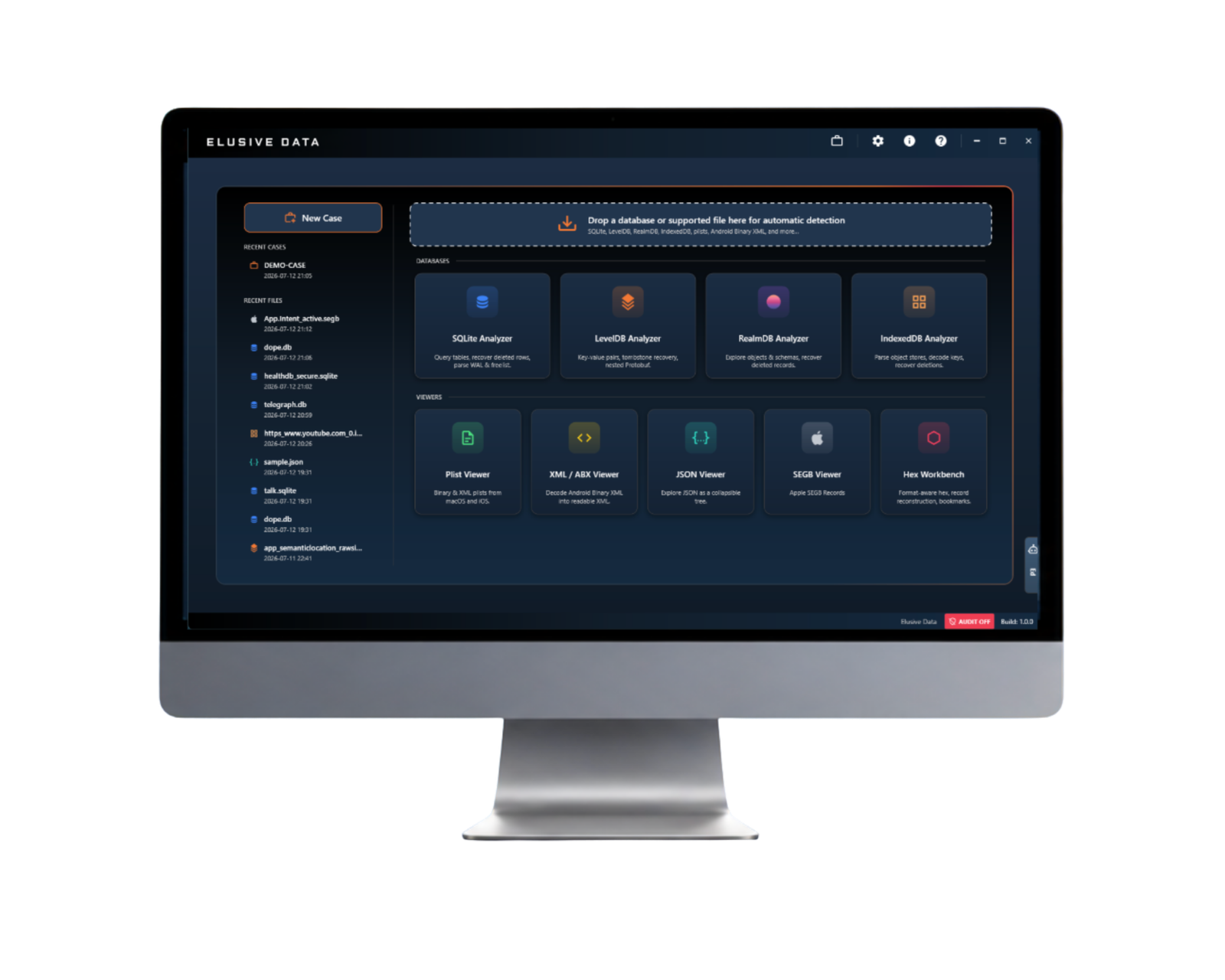
Elusive Data Firefly follows this same idea. Firefly is a forensic workspace for app-data investigations built around provenance: recovering what remains, interpreting it in context, validating findings against the source and preserving the path back to the supporting artifacts.
The point is not to make examiners abandon the tools they already trust. Extraction platforms do important work. A source-backed workspace is about the work that often begins after extraction: checking what the data means, understanding what remains beneath the decoded view and keeping the source context available when a finding needs to be explained.
In Firefly’s case, that work extends beyond SQLite into modern app-data sources such as RealmDB, LevelDB, IndexedDB and Apple Biome / SEGB. The common thread is provenance: keeping recovered data, interpretation and source artifacts connected.
Questions that help keep findings source-backed
Provenance does not need to be complicated. It often begins with a few practical questions that keep the investigation connected to the source.
- Where did this finding come from?
- Which file, database, stream or structure supports it?
- How was the value interpreted?
- Is there another plausible reading?
- Can the source bytes or structure be checked?
- Does the report preserve enough context for review?
When those questions can be answered clearly, the finding becomes easier to discuss, review and defend.
Forensic Provenance FAQ
What does provenance mean in digital forensics?
Provenance describes the connection between a finding and the source artifacts that support it. It helps explain where the finding came from, how it was interpreted and whether the examiner can verify it against the source.
Why is provenance important after extraction?
Extraction gets data into a workable form. Provenance helps the examiner understand and validate what the data means, especially when a finding is important, incomplete, deleted, historical or interpreted differently by different tools.
How does provenance help with SQLite evidence?
SQLite provenance can connect a finding to a database, page, record, WAL frame, freelist page, freeblock, overflow page or byte offset. That makes the interpretation easier to validate and explain.
Is SHM a normal source of database content?
No. In SQLite WAL mode, the SHM file is part of the WAL-index mechanism. It helps coordinate access and locate WAL frames, but it is different from treating the main database or WAL file as a direct content source.
How does provenance support reporting?
Provenance keeps the interpretation connected to the source. That helps peer review, quality assurance and reporting because the examiner can show how a finding was reached and what source material supports it.